
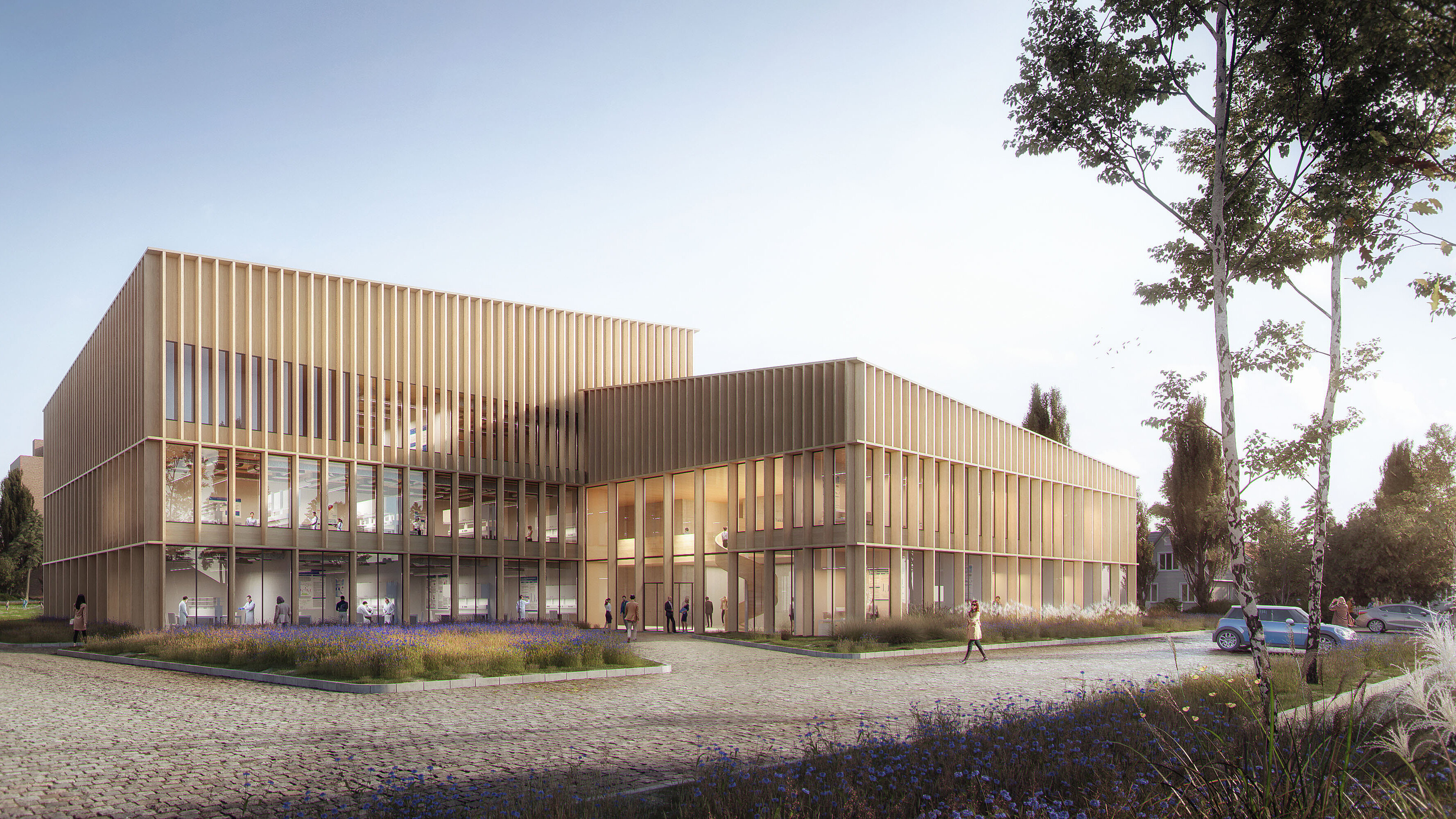
Centre for Individualised Infection Medicine
The CiiM (Centre for Individualised Infection Medicine) is a joint initiative of the Helmholtz Centre for Infection Research (HZI) in Braunschweig and the Hannover Medical School (MHH).
The research groups based at CiiM are exploring the influence of individual patient and pathogen conditions on susceptibility to infection, disease progression and therapeutic success. The aim is to optimise individual patient care.
The realisation of this vision requires an interdisciplinary, patient-oriented collaboration between different clinical and research departments. The construction of a dedicated CiiM building in the immediate vicinity of the MHH and the other research facilities at the biomedical hub in Hannover is of great importance in this regard. This investment by the federal government via the Helmholtz Association and the state of Lower Saxony will also be a key factor for future investments and industrial collaborations.
![[Translate to English:] CiiM Forschung](/fileadmin/_processed_/5/f/csm_AdobeStock_32892363_fd4ab10ffb.jpeg)
What's behind it all
CiiM combines clinical and scientific expertise from infection research and medicine for a future-oriented individualised infection medicine.
The idea for a centre dedicated to individualised infection medicine first arose in 2013. Two years later, in 2015, the partner institutes of the HZI and the MHH signed the letter of intent for the joint establishment of CiiM and completed the foundation of the initially virtual CiiM.
The planned CiiM building will be constructed in close proximity to the Centre for Experimental and Clinical Infection Research TWINCORE and the MHH and will house modern laboratories, technology platforms and informatics interfaces on approximately 2,100 sqm of floor space upon completion.
The Helmholtz Association, the State of Lower Saxony and the Helmholtz Centre for Infection Research are providing €25 million for the construction of the CiiM building.
![[Translate to English:] CiiM Leitbild](/fileadmin/_processed_/3/6/csm_190604_slider3_copyright-Debarry-CiiM_8535afb552.jpg "[Translate to English:] CiiM Leitbild")
Vision, mission and strategy
The vision driving CiiM is the individual prognosis and diagnosis of infectious diseases and tailor-made prevention and therapy for the benefit of the individual patient.
To realise this vision, interdisciplinary teams at CiiM are studying individual infection courses. Existing routine data from the clinic are brought together with newly collected molecular data of the individual patients and pathogen to generate predictive parameters for the course of infection and therapeutic success using computer-assisted methods. This patient-centred and data-based approach of the CiiM provides the treating physician with an important guidance for tailored prevention and therapy, thus enabling individualised patient management and evidence-based medicine.
Based on our mission statement, we have developed a strategy for the coming years that will allow us to build an innovative center in Hannover that can address the pressing issues in infectious medicine for the benefit of the individual patient.
The strategy
At CiiM, the focus is on the individual patient and their best possible treatment. For this, a comprehensive overview of the current state of research is crucial in addition to clinical expertise. Therefore, all CiiM activities are based on a concrete clinical need and aim at improving patient treatment.
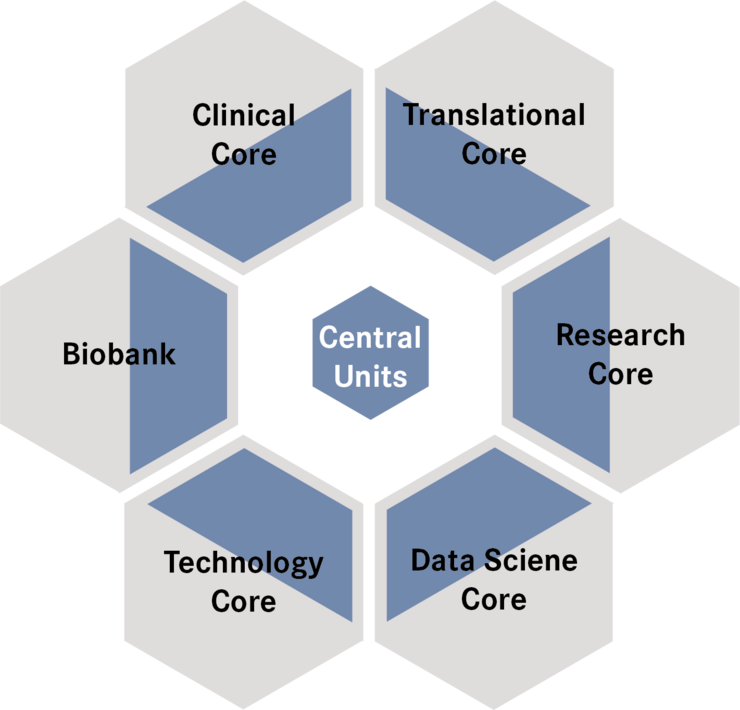
Patient cohorts are defined for questions and problems in infectious medicine that are relevant in everyday clinical practice (Clinical Core), and the included patients are systematically subjected to in-depth characterisation (e.g. molecular diagnostics) that goes beyond routine diagnostics. In this context, the accommodation of patient-related and study-related services at CiiM will facilitate the inclusion of patients. Furthermore, outpatient rooms at CiiM will allow monitoring of patients beyond their hospital stay, which is critical for a temporal and dynamic resolution of the infection and healing processes as well as the effects of therapy.
For molecular diagnostics, genomics and post-genomics technologies will be established at CiiM with connected laboratory space for sample preparation including a central pipetting laboratory with robotics and connected office space for data processing (Technology Core). In addition, the establishment of a group for the technological (co-)development and testing of innovative measuring devices (e.g. wearables, point-of-care diagnostics) is planned. Furthermore, the operation of a branch of the Hannover Unified Biobank at CiiM will enable the processing and storage of infectiological samples and ensure direct connection to the central biobank (Biobank).
Data scientists will integrate the clinical data of the patients available, for example, via the MHH's Clinical Data Warehouse, link them with the newly acquired data and analyse them (Data Science Core). With the help of various methods of modeling and simulation, predictive models are created on the basis of these data collections, which, for example, provide indications of possible biomarkers or reveal relationships that are not yet known. With the help of learning models (artificial intelligence), the available data allow patients to be classified on the basis of parameters already collected and can be translated directly into treatment recommendations such as therapy optimisation.
These individualised approaches are validated and utilisedin prospective studies in everyday clinical practice (Translational Core). In addition, new therapeutic options are being explored for specific patient groups and the testing of promising strategies in clearly defined patient groups is being prepared with the support of the central CiiM units on ethical issues, quality assurance, standardisation, study support and coordination (Central Units). These units will also support the establishment of new fields of research, foster interaction between expert cores and accelerate translation of results.
In parallel, the deciphering and experimental validation of the underlying mechanisms of the developed models and biomarkers (Research Core) is performed in cooperation with the HZI and TWINCORE. The mechanistic understanding gained in this way will enable the targeted further development of therapeutic strategies.


