Infection Biology

Research Focus
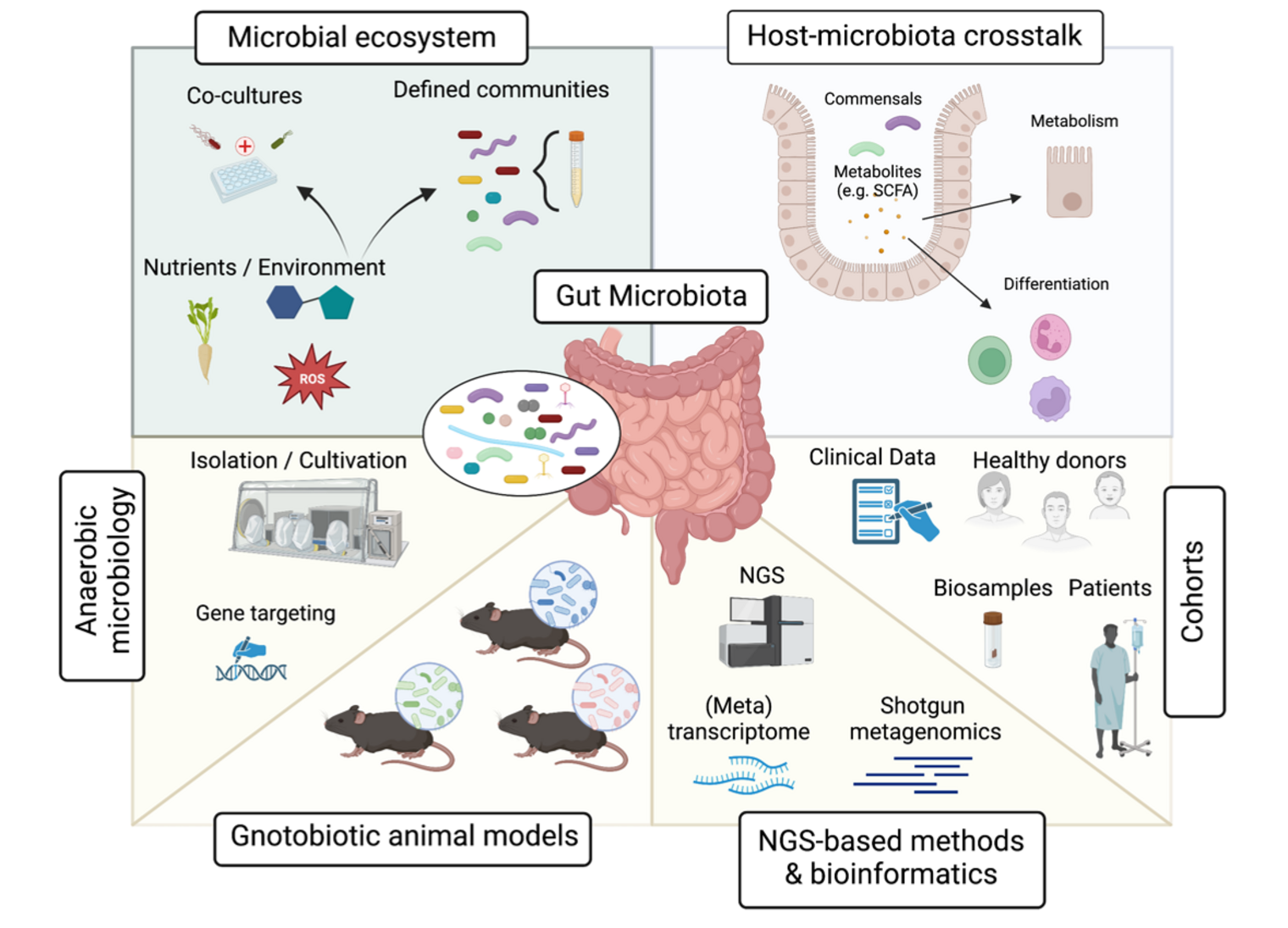
Despite significant progress and important findings in microbiome research over recent years, the development of new drugs based on these insights remains in its early stages. This is because it is often unclear which members of the microbiome and which specific mechanisms are responsible for health-promoting and harmful effects. Therefore, we have developed methods and models in recent years to analyze the complex interactions among pathogens, the microbiome, and the host. This allows us to gain new insights into how manipulating microbial communities can be used therapeutically. Our research has focused on two key areas: firstly, the role of widespread yet uncharacterized members of the gut microbiome in the microbial ecosystem; and secondly, the potential of microbiome components to promote the exclusion of multidrug-resistant enterobacteria, such as Klebsiella pneumoniae and Escherichia coli, from the gut. By combining basic and translational research, we aim to fully exploit the microbiome's potential as both a biomarker and a therapeutic target.
Research Focus
Despite significant progress and important findings in microbiome research over recent years, the development of new drugs based on these insights remains in its early stages. This is because it is often unclear which members of the microbiome and which specific mechanisms are responsible for health-promoting and harmful effects. Therefore, we have developed methods and models in recent years to analyze the complex interactions among pathogens, the microbiome, and the host. This allows us to gain new insights into how manipulating microbial communities can be used therapeutically. Our research has focused on two key areas: firstly, the role of widespread yet uncharacterized members of the gut microbiome in the microbial ecosystem; and secondly, the potential of microbiome components to promote the exclusion of multidrug-resistant enterobacteria, such as Klebsiella pneumoniae and Escherichia coli, from the gut. By combining basic and translational research, we aim to fully exploit the microbiome's potential as both a biomarker and a therapeutic target.
Prof Dr Till Strowig
Humans are carriers of diverse microbial ecosystems that influence our daily life. To understand our interactions with these ecosystems we need model systems that allow experimental manipulations of both the host and the microbes.

Till Strowig studied Medical Biotechnology at the “Technische Universität” Berlin. After his diploma thesis at The Rockefeller University in New York, he remained there for his Ph.D. thesis supported by a fellowship from the Boehringer Ingelheim Foundation. He continued his scientific training in the laboratory of Richard Flavell at Yale University supported by a postdoctoral fellowship from the Leukemia and Lymphoma Society. Since June 2013, Till Strowig is heading the Young Investigator Group “Microbial Immune Regulation“ at the HZI, which has grown into the department of the same name since February 2019.
Projects
Interindividual differences in the (gut) microbiota are considered to be a key factor in determining the clinical outcome of various infectious and immune-mediated diseases. In recent years, we have used germ-free and gnotobiotic mouse models to demonstrate that the microbiota influences susceptibility to bacterial infections, and that customized microbiome editing can reduce this susceptibility (Osbelt et al., 2021). The targeted modification of the microbiota using novel antibiotics can also provide health benefits (Bublitz et al., 2023). Concurrently, we are investigating individual members of the microbiome, such as Segatella copri, to elucidate its role in human health (El Mouali et al., 2024, and El Mouali, Tawk et al., 2026). Current projects focus on investigating the mechanisms responsible for the interaction between pathogens and the microbiota (Osbelt et al., 2024; Wende et al., 2025). Additionally, we are participating in the RESET-MDR study. This study investigates whether a combination of antibiotic pretreatment and fecal microbiota transplantation (FMT) can reduce or eliminate colonization of the gut by multidrug-resistant Enterobacteriaceae. Different variants of FMT (conventional and personalized) are being compared to determine the most effective treatment.
Team
Until the building is completed, the group is based at the HZI campus. You can find the current team list here.
Publications
- Wende M, Osbelt L, Eisenhard L, Lesker TR, Damaris BF, Mutukumarasamy U, Bielecka A, d. H. Almási É, Winter KA, Schauer J, Pfennigwerth N, Gatermann S, Schaufler K, Schlüter D, Galardini M, Strowig T. Suppression of gut colonization by multidrug-resistant Escherichia coli clinical isolates through cooperative niche exclusion. Nature Communications 2025 Jul;16(7):5426. DOI: https://doi.org/10.1038/s41467-025-61327-7
El Mouali Y, Tawk C, Huang KD, Amend L, Lesker TR, Ponath F, Vogel J, Strowig T. The RNA landscape of the human commensal Segatella copri reveals a small RNA essential for gut colonization. Cell Host Microbe. 2024 Nov 13;32(11):1910-1926.e6. DOI: 10.1016/j.chom.2024.09.008.
Osbelt L, Almási E, Wende M, Kienesberger S, Voltz A, Lesker TR, Muthukumarasamy U, Knischewski N, Nordmann E, Bielecka AA, Giralt-Zúñiga M, Kaganovitch E, Kühne C, Baier C, Pietsch M, Müsken M, Greweling-Pils MC, Breinbauer R, Flieger A, Schlüter D, Müller R, Erhardt M, Zechner EL, Strowig T. Klebsiella oxytoca inhibits Salmonella infection through multiple microbiota-context-dependent mechanisms. Nat Microbiol. 2024 Jul;9(7):1792-1811. DOI: 10.1038/s41564-024-01710-0.
Bublitz A, Brauer M, Wagner S, Hofer W, Müsken M, Deschner F, Lesker TR, Neumann-Schaal M, Paul LS, Nübel U, Bartel J, Kany AM, Zühlke D, Bernecker S, Jansen R, Sievers S, Riedel K, Herrmann J, Müller R, Fuchs TM*, Strowig T*. The natural product chlorotonil A preserves colonization resistance and prevents relapsing Clostridioides difficile infection. Cell Host Microbe. 2023; May 10;31(5):734-750. DOI: 10.1016/j.chom.2023.04.003
Osbelt L, Wende M, Almási E, Derksen E, Muthukumarasamy U, Lesker TR, Galvez EJC, Pils MC, Schalk E, Chhatwal P, Färber J, Neumann-Schaal M, Fischer T, Schlüter D, Strowig T. Klebsiella oxytoca causes colonization resistance against multidrug-resistant Klebsiella pneumoniae in the gut via cooperative carbohydrate competition. Cell Host & Microbe. 2021; 29(11), 1663-1679. DOI: 10.1016/j.chom.2021.09.003.
Newsroom